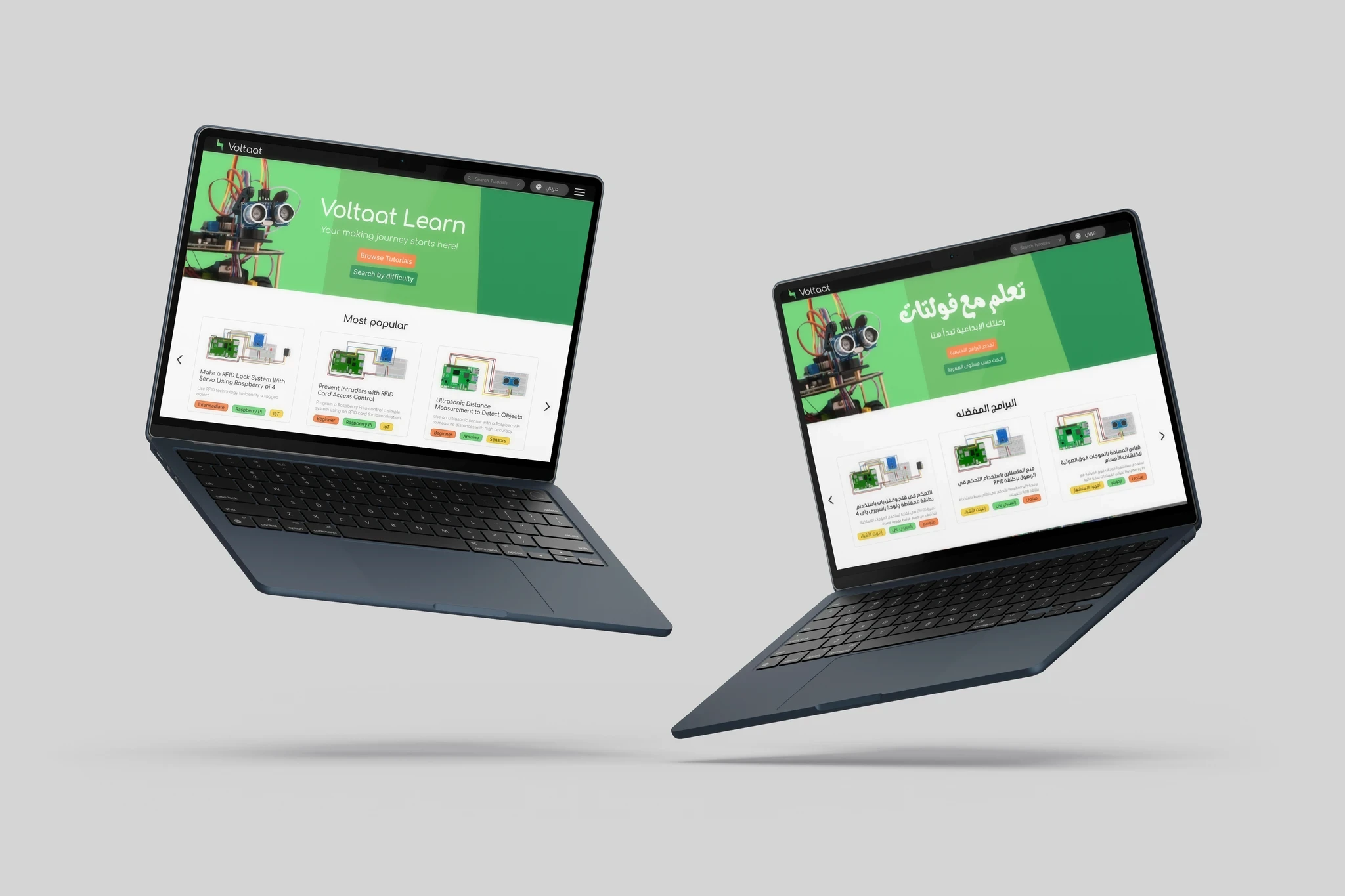
Voltaat Learn
Library of educational resource guides
Product Design
UX Research
Growth Strategy
METHODS
Customer journey mapping · Persona development · User flow design · Feature prioritisation
INDUSTRY
Edtech · Maker hardware
LOCATION
Doha, Qatar
Prior to this project, Voltaat Learn was a simple blog consisting of a flat list of text-based posts with no navigation logic, no learning hierarchy, and no way for a user to find what they needed. The platform wasn't contributing to product sales, community building, or customer retention in any meaningful way. This project set out to understand who was actually trying to use the platform, what they needed from it, and what a version of Voltaat Learn that served them would look like.


A Truly Magical Experience!
A robotics and maker hardware brand lives or dies by whether customers can actually use their products. A customer who gets stuck, feels frustrated, gives up, and stops trying. Instead of feeling empowered, they leave with a general feeling that the product was too complex or that it was not intended for them. Voltaat Learn was meant to be the bridge between buying a kit and successfully building something with it.
Research question: Who is trying to use Voltaat Learn, what are they trying to do, and where is the platform failing them?
Context & Constraints
Voltaat Learn sat at the intersection of several competing needs: educational resource, product discovery tool, community platform, and post-purchase support channel. Any redesign had to serve all of these functions without collapsing into something that served none of them well.
The user base was also diverse spanning students, hobbyists, working professionals, and beginners, with significantly different goals, time availability, and levels of technical confidence. A single information architecture couldn't serve all of them equally. The design had to make deliberate choices about priority and flow.
Customer journey mapping
Mapped the full customer journey across five stages: discovery, website, fulfillment, retention, and feedback, to understand how different users arrived at Voltaat Learn, what they were trying to accomplish, and where the experience broke down. The mapping was conducted across user types rather than as a single generic journey, surfacing the divergence points where different users needed different things.
Persona development
Four research personas emerged from the journey mapping work, each representing a distinct user type with distinct needs:
Ahmad — Engineering graduate seeking practical project experience on a limited budget and time. Needs content categorised by relevance to applications, not by product type.
Lina — Computer science student who needs clear guidance on which products suit her level and how they expand her skillset. Needs a guided, confidence-building experience.
Khaled — Full-time electrical engineer applying skills to real projects, trying to stay current. High technical confidence; needs community, challenge, and peer recognition.
Hala — Electrical engineering student building university projects to impress professors. Needs access to complete materials lists, linked products, and structured project guides.
Feature prioritisation
Features were mapped against personas across four themes: 1. Product Cohesion, 2. Guided, 3. Practical/Relevant, and 4. Interactive, to surface what each user type most needed and where the current platform was failing them most acutely. This prevented the redesign from being driven by what the team thought was interesting rather than what users actually needed.
User flow design
Two distinct flows were designed, reflecting a key finding from the journey mapping: users who already owned Voltaat products had fundamentally different navigation goals from users who hadn't yet purchased.
Flow 1 — Existing owners: Open → Find tutorial → Follow → Share/comment → Acquire missing items
Flow 2 — Non-owners: Open → Explore → Browse → Click tutorial → Purchase → Follow → Share
Designing both flows separately prevented the common trap of optimising for one user type at the expense of the other.


Solution
Finding 1: The platform had no logic for different user entry points. Users arriving to follow a specific tutorial and users arriving to browse without a clear project in mind were being served exactly the same experience. Both were failing, but for different reasons.
Finding 2: Content was organised for the team, not for the user. The existing structure reflected how Voltaat internally categorised its content: by product type. Users, by contrast, were looking by difficulty level, by project goal, by time available, and by what they already owned. The mismatch was total.
Finding 3: The guided experience was completely absent. Lina and Hala, users with less confidence who needed scaffolding, had nothing to orient them. No recommended starting point, no learning path, no signal about what was appropriate for their level. The platform implicitly assumed users already knew what they wanted.
Finding 4: Video was the missing format. The text-heavy blog format wasn't working for any user type. The journey mapping surfaced a consistent preference for video tutorials, particularly for hands-on hardware assembly tasks where text instructions without visual demonstration produced frequent failure and frustration.


Concept
The site was rebuilt from scratch. The existing structure was too deeply misaligned with how users actually navigated to be salvageable through iteration. New information architecture was built around the four user types and the four prioritization themes.
Two user flows replaced one. The split between existing-owner and non-owner flows was implemented as distinct navigation pathways, allowing each user type to reach their goal without being routed through steps designed for the other.
The research drove a content strategy decision. The finding that video was the preferred format and that text-only tutorials were producing drop-off and frustration directly informed the decision to begin producing video content. This was a significant investment for a small team, and the research provided the evidence base to make the case for it.
Marketing materials were developed to bridge the platform and the retail experience, linking the digital educational resource to the in-store product range.
Outcomes
Platform rebuilt from a non-functional blog to a structured educational platform with distinct user flows and a feature set mapped to four user types
Video content production initiated, a new content format introduced based directly on research findings
Contributed to 15% increase in first-time buyers post-launch, the platform became a functional part of the customer journey and fed into 2x revenue growth and second funding round achieved during the same period.

