Bryck
AI assistant for construction & trade teams
AI
B2B SaaS
UX Research
METHODS
Pretotype studies · Moderated interviews · Workflow simulation · Synthesis
INDUSTRY
Construction
LOCATION
London, UK
End-to-end product design and devleopment process that included discovery research and pretotype studies that validated willingness to pay prior to development.


The problem with the independent construction industry.
Construction and trade teams are notoriously hard to sell software to. Adoption of project management tools in this sector is low, particularly for independent contractors. Despite that, the problems that they face persist. The inspiration for this project came from the sheer amount of conversations we had with individuals who described to us in great detail the issues when they embark on residential renovation projects.
Unfortunately, adoption for these tools in the market is not currently hight. Most tools require behavior change that doesn't fit how small site teams naturally work.
Before embarking on a full-blown business venture, we aimed to validate commercial readiness by asking the following question: If we adapted the process to the channels that teams naturally use, would adoption barriers drop significantly? If true, would trade contractors and their clients be willing to invest in a solution that could solve this problem?

Phase 1: Generative interviews
We started by moterating interviews with trade contractors to understand coordination pain points: how they currently communicate on-site, where things fall through the cracks, and what tools they'd tried and stopped using.
Phase 2: Pretotype studies
The next step was to simulate the product experience manually to test whether the core behaviur would happen before investing in development. Testing willingness to engage and willingness to pay at the lowest possible build cost.
Phase 3: Workflow simulation
Designed n8n-powered workflow simulations to model user journeys before live sessions using AI to generate realistic outputs and map edge cases ahead of time, compressing the feedback loop.
Synthesis: All sessions synthesised in Dovetail. Tagging, clustering, and surfacing patterns across participants.



Coordination was a real problem.
Every contractor described the same failure mode: information in individual chats is not centralized, and follow-up manual and unreliable. Project management apps had been tried and tossed aside fairly quickly due to the fact that they required a steep learning curve and significant investment upfront.
The results concluded a significant discovery: contractors are unwilling to change their existing behavior without clear proof of value.
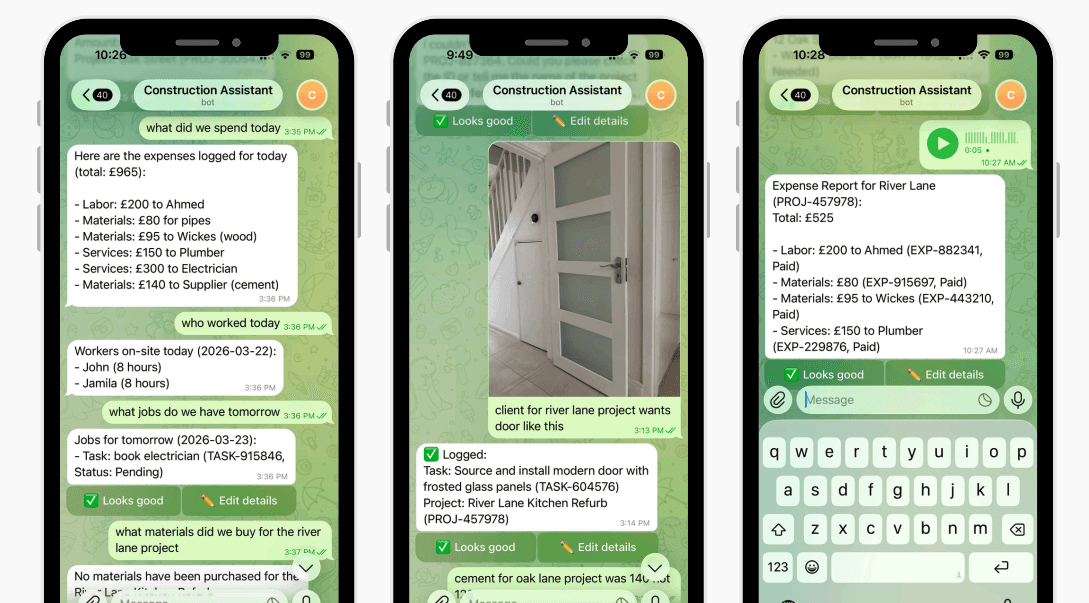
Contractors weren't going to switch communication tools. That barrier was simply too high and instead of resisting it, we hypothesized that we could deliver even more value by working with it. For this reason, WhatsApp integration became a non-negotiable.
We conducted numerous experiments moving beyond an MVP, to reach what we hoped would be the "minimum buyable product" or MVB. From the research, we had concluded that willingness to pay was conditional on proof. Contractors were willing to pay but only for demonstrably time-saving features on specific high-pain tasks.
We refined the offering optimizing purely for conversion. The goal was to deliver specialized value in a significant and measurable way prompting testers to become long-term users.


The pretotype phase killed two product directions before they were built, and allowed us to zone in on where we could offer the most value early-on, saving significantly on development time.
Willingness to pay being tied to specific tasks directly shaped roadmap sequencing. We prioritised those features first rather than building a complete product before testing commercial viability.
Outcomes
Willingness-to-pay validated before development began
Beta launched [March 2026] with profitability achieved within 1 week of deployment
Two product directions dropped in pretotype phase before build cost
Research-led practice established from day one in a 0→1 context
Reflection
The biggest tension in founder-led research is objectivity. When you've built a hypothesis and you're running the sessions, confirmation bias is a real risk — participants will often tell you what they think you want to hear, especially if you've been warm in building the relationship.
The pretotype approach helped with this because it moved the test from "do you like this idea?" to "will you actually use this?"
Throughout this project, we had the opportunity to work with a large number of users from immigrant and minority backgrounds. This population is generally hesitant to participate in research, and have a greater tendency to self-exclude, despite their continued usage of the technology.
To address this, we took the time to build rapport and immerse ourselves in their environment. Looking back, this was the most fulfilling part of the project, to be able to deliver value to a group that is often underserved by tech teams.